Let’s start with a moment of honesty. When someone asks how you’ve grown your business, the answer is probably some version of: ‘Mostly word of mouth. Our clients refer us to their networks.’
And you should feel good about that. It means your work is excellent. Your clients trust you enough to stake their own professional reputations on recommending you. In a relationship-driven industry like life sciences — where a bad vendor can derail a regulatory submission or compromise a quality system — that kind of trust is everything.
So what’s the problem?
The problem is that referrals, as a growth strategy, are completely outside your control. And in business, what you can’t control, you can’t scale — and you can’t protect.
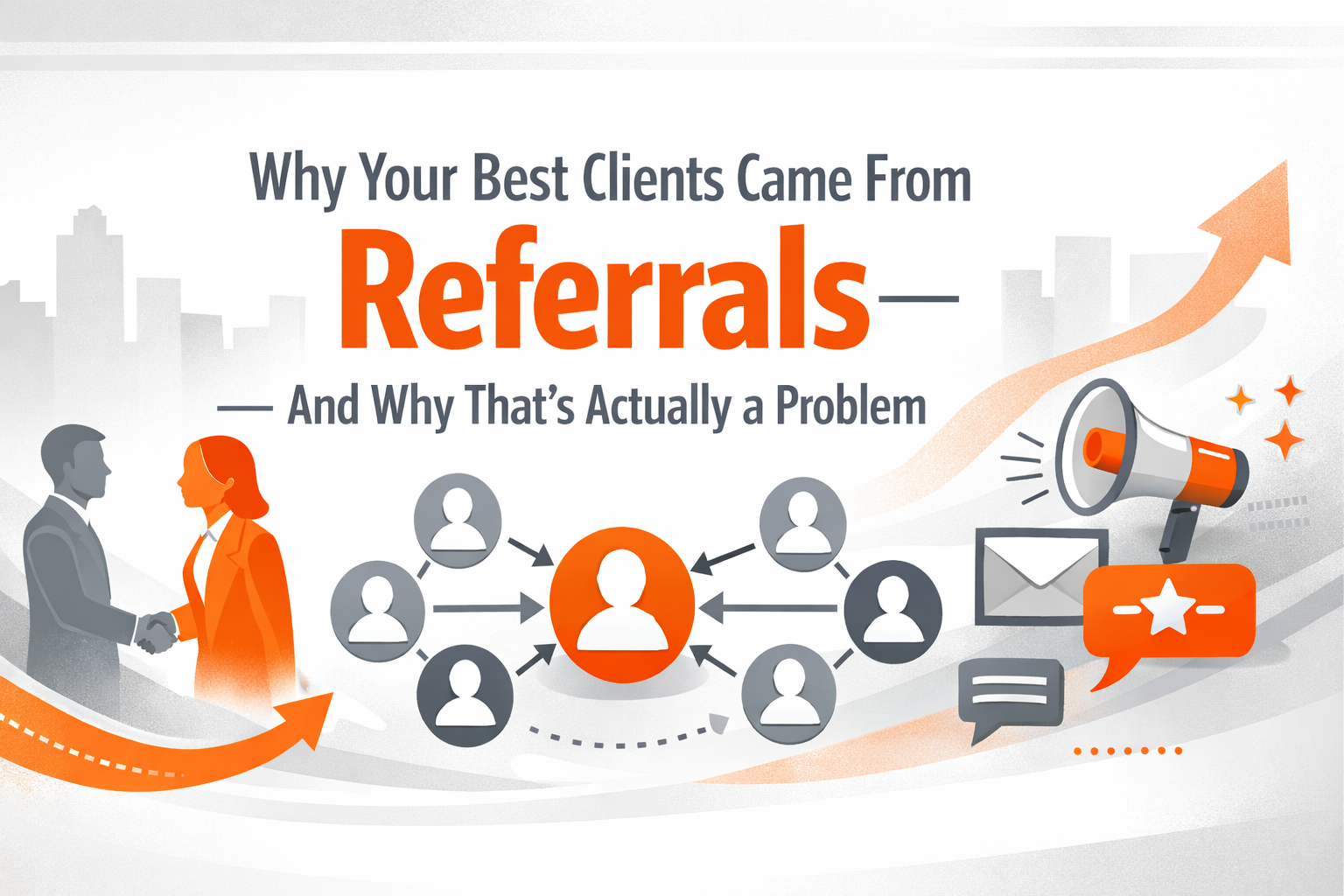
Referrals are a reward for great work. They are not a growth strategy.
The Referral Trap: Why It Feels Safe Until It Isn’t
Referral-driven businesses tend to grow steadily — until they don’t. And when growth stalls, owners are often blindsided, because everything was going so well.
Here’s what’s actually happening beneath the surface of a referral-dependent firm:
- Your pipeline is invisible. You have no real visibility into where your next client is coming from or when. You’re waiting — and hoping.
- Your growth is capped by your network. You can only grow as fast as your existing clients refer, and as wide as their networks reach. If they don’t know the right people, neither do you.
- You’re vulnerable to relationship disruption. A key contact retires. A longtime client gets acquired. A champion at a pharma company moves to a competitor. Any of these can quietly dry up a referral stream you didn’t even realize you were depending on.
- You can’t target the clients you actually want. Referrals are democratic — they bring whoever your clients happen to know. That might not be the segment, company size, or service need that aligns with your growth goals.
- You have no mechanism to accelerate. When you need to grow faster — because you’ve hired, because the market shifted, because a competitor entered your space — referrals don’t respond to urgency.
None of this means referrals are bad. It means they are insufficient on their own.
The Life Sciences Dimension: Why This Is Especially True in Your Market
If you provide regulatory consulting, quality services, specialized IT, product testing, or FDA submissions to pharma, biotech, or medical device companies, your market has some specific characteristics that make referral dependency even riskier.
Your buyers change roles frequently. The VP of Regulatory Affairs who referred you twice just took a role at a CRO. The Quality Director who loved your work retired. In life sciences, talent moves constantly — and your referral network moves with them.
Your buying cycle is long and relationship-dependent. Pharma and biotech companies don’t make vendor decisions quickly. They evaluate carefully, often over months. If you’re not visible during that evaluation period — if they’ve never heard of you outside of a single referral — you’re starting from zero every time.
The market is consolidating. Larger CROs and consulting firms are acquiring smaller specialists. They have marketing budgets, brand recognition, and sales teams. The firms that survive as independents will be the ones that built a brand and a presence — not just a reputation among a small network.
New opportunities are emerging in subsegments you may not be connected to. Cell and gene therapy, digital health, companion diagnostics — these growth areas have their own buyer communities. Referrals won’t get you there if your current network doesn’t operate in those spaces.
What a Referral-Dependent Business Looks Like From the Outside
Here’s a useful exercise. Think about what a potential new client experiences when they hear your name for the first time — not from a referral, but on their own.
They might search your company name. What do they find? A website that lists your services but doesn’t explain why you specifically are the right choice? A LinkedIn page that hasn’t been updated in months? No case studies, no articles, no evidence of a point of view?
Now compare that to what they find when they search a competitor who has been investing in marketing. Thought leadership articles. A clear positioning statement. Client results (even if anonymized). A founder or leadership team with a visible voice in the industry.
Which firm looks like the safer choice to a buyer who doesn’t yet have a warm introduction?
This is the invisible cost of referral dependency: your reputation doesn’t travel beyond your network. And in a market where buyers increasingly do their own research before ever contacting a vendor, that matters more every year.
If a qualified buyer searches your firm and finds nothing compelling, a referral may not be enough to save the deal.
What a More Resilient Growth Model Looks Like
The goal isn’t to replace referrals — they will always be valuable and you should keep nurturing them. The goal is to build a marketing engine that generates opportunities independently of who your current clients happen to know.
For life science service firms, that typically means building in a few key areas:
Clear positioning. A precise, differentiated answer to why a pharma or biotech company should choose you over every other option. Not a laundry list of services — a specific value proposition for a specific buyer.
Thought leadership. Content — articles, LinkedIn posts, speaking, podcasts — that demonstrates your expertise and earns trust before a conversation ever happens. This is how you become known beyond your immediate network.
A website that converts. Not just a digital brochure, but a site that communicates your positioning clearly, provides evidence of your expertise, and makes it easy for a qualified buyer to take the next step.
Strategic visibility. Being present where your buyers are — at industry conferences, in the publications they read, in the LinkedIn communities they follow — so you’re familiar when the need arises.
A consistent lead nurturing approach. A way to stay in front of potential clients over the long buying cycle, so that when their need becomes acute, you’re the first firm they think of.
A Note on Timing
The firms we see struggle most with this transition are the ones who wait until growth stalls to address it. By then, they’re reacting from a position of pressure rather than building from a position of strength.
The best time to build a marketing foundation is when business is good — when you have the bandwidth to do it thoughtfully and the results to use as proof points. The referrals are still coming in, and you’re using that runway to build something that doesn’t depend on them.
The second best time is right now.
The best time to build a marketing foundation is when business is good. Don’t wait for the pipeline to dry up.
The Bottom Line
Your referral-driven growth is a testament to the quality of your work and the relationships you’ve built. That’s genuinely impressive — and it’s a foundation to build on, not a strategy to rely on.
The life sciences services market is getting more competitive, buyers are more self-directed in their research, and the firms that will thrive over the next decade will be the ones that built a brand — not just a reputation.
If you’ve been thinking about marketing but haven’t known where to start, this is the moment to have that conversation. Not because your referrals are drying up, but because building a resilient growth engine while you’re strong is always better than scrambling when you’re not.
Ready to build a marketing strategy that works alongside your referrals — not instead of them?
BrandUp Strategy works exclusively with life science service providers to build brands, generate demand, and create sustainable growth. Let’s talk.
brandupstrategy.com | 813-435-3636